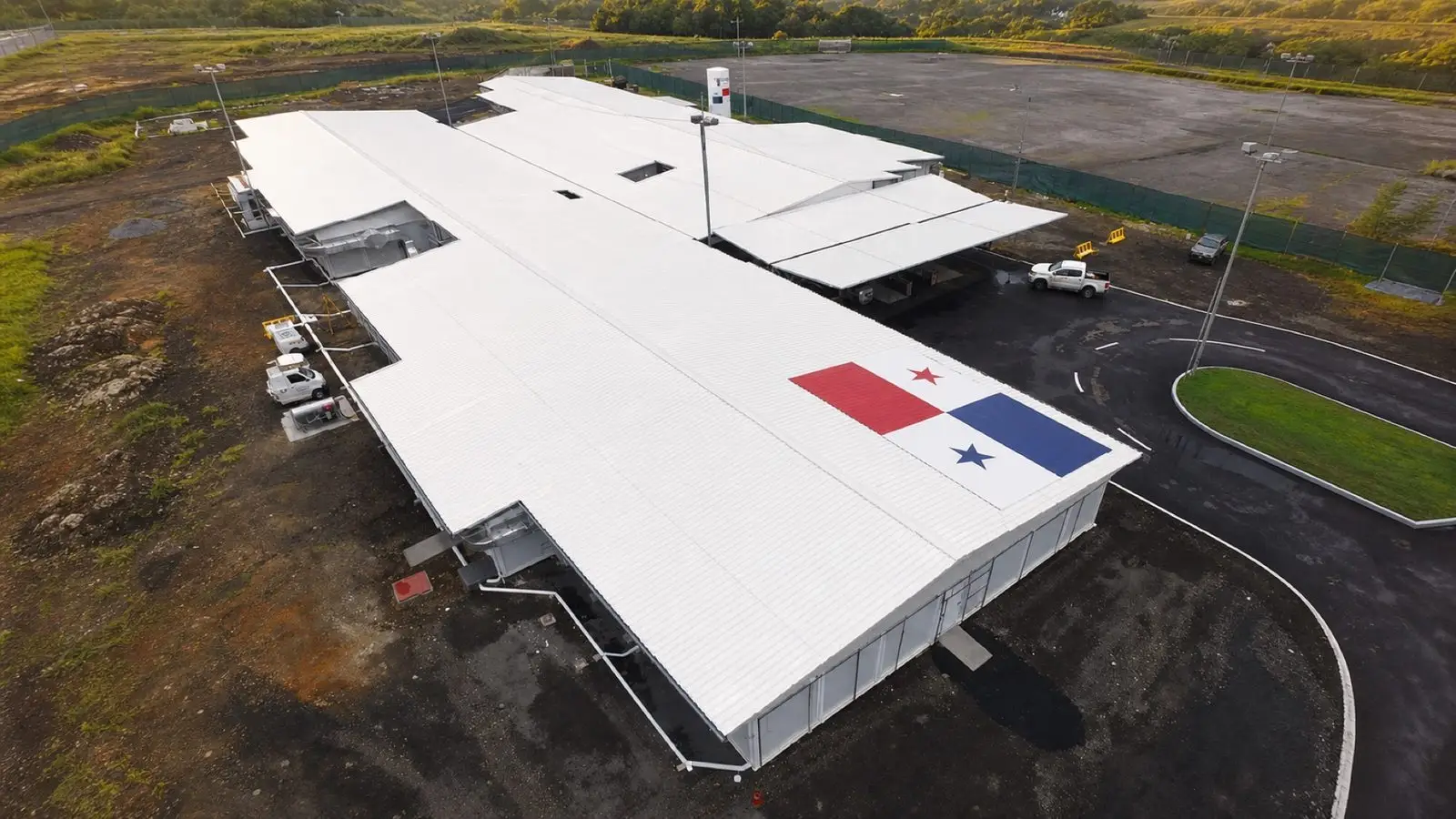
Healthcare capacity operating in 30 days
The Hospital Modular in Panama City — 2,430 m² turnkey — was delivered in 30 days. Modular hospitals and prefabricated health posts with MEP pre-integrated at the plant, expandable in phases and compliant with NSR-10 and REP-2021, for health networks that cannot wait years of construction.
- Hospital Modular: 2,430 m² delivered in 30 days in Panama City — the fastest delivery of the group's modular system.
- MEP pre-integrated at the plant: electrical and plumbing installations fitted in every module before dispatch.
- Interconnectable modules: capacity grows in phases with demand and relocates when the need moves.
- Turnkey: from BIM design and engineering to fit-out, under one contract and one responsible party.
Speed that saves capacity.
When demand for care grows faster than infrastructure, every month of construction is measured in patients not attended.
In healthcare the construction schedule is not an administrative variable: it is care capacity that either exists or does not. A health emergency, a saturated hospital or a network that needs health posts in remote areas cannot wait the years a traditional hospital project takes — wet, sequential works exposed to the delays of coordinating multiple contractors. Adding beds, consulting rooms or support services requires a building system that answers in weeks, not years.
Modular construction reverses that sequence. While civil works advance on the site, the modules are fabricated in parallel at the group's CNC plant (NewCon Steel®, Las Mañanitas · EMMA regime) in Zn-Al-Mg 275 g/m² steel with a ±0.5 mm fabrication tolerance — and they leave the factory with the MEP pre-integrated: electrical and plumbing installations fitted before dispatch. On site, installation takes weeks with dry assembly, up to 90% faster than traditional construction and with up to 30% less construction waste.
The evidence is concrete: the Hospital Modular in Panama City — 2,430 m² — was delivered in 30 days. For permanent, larger-scale healthcare buildings, steel framing complements the modular line. In both cases the project is delivered turnkey — from BIM design and engineering to fit-out — calculated to NSR-10 in Colombia and REP-2021 in Panama, with electrical installations under RETIE and inside the ISO 9001 · 14001 · 45001 · 37001 quality system of PEB Corp Group.
Six advantages for healthcare infrastructure.
What the modular system solves in hospitals and health posts — with evidence from delivered projects.
-
01
30 days of real evidence
The Hospital Modular in Panama City — 2,430 m² turnkey — was delivered in 30 days. Not a projection: a documented project of the group's portfolio.
-
02
Hospital MEP pre-integrated
Electrical and plumbing installations are integrated in every module at the plant, before dispatch. On site they are only interconnected — electrical installations under RETIE in Colombia.
-
03
Expandable module by module
Interconnectable modules grow in phases: capacity is extended by adding modules as service demand grows, without demolishing what is built or stopping operations.
-
04
Surfaces and flows designed for asepsis
The layout is defined room by room in the BIM model: differentiated circulations and flows, and finishes specified to ease cleaning and disinfection — before fabrication.
-
05
Relocatable when needs change
Modules are dismantled and moved: the infrastructure follows demand — from a health emergency to a permanent site — instead of sitting idle.
-
06
NSR-10 · REP-2021 · RETIE compliance
Every project is designed and calculated to the code of its jurisdiction: NSR-10 in Colombia, REP-2021 in Panama and IBC where applicable, with electrical installations under RETIE and permit documentation included.

Interconnectable modules · MEP pre-integrated before dispatch
Hospital Modular: 2,430 m² in 30 days.
The project that proves the timeline — verifiable area, time and location in the portfolio.
The Hospital Modular in Panama City concentrates the complete proposition of the system in 2,430 m²: modules fabricated at the group plant with pre-integrated MEP, transport, on-site installation and turnkey delivery in 30 days. It is the delivery record of the group's modular system — no other documented project in the portfolio was delivered faster.
The timeline was not achieved by rushing a traditional build but by changing the sequence: module fabrication advanced in parallel with the civil works, and every module reached the site with its electrical and plumbing installations already fitted. On site, the work was reduced to interconnecting, executing service connections and fitting out. The same scheme applies to prefabricated health posts — deployed in weeks — and to phased hospital expansions with the existing operation running.
Timelines, MEP and codes for the healthcare sector.
The data a health authority or hospital operator needs to evaluate the modular option.
- Health posts
- Deployment in weeks — prefabricated modules with pre-integrated MEP, relocatable
- Modular hospital
- 30 days proven (Hospital Modular, 2,430 m², Panama City) · complete projects in 60–120 days depending on scope
- MEP
- Pre-integrated at the plant: electrical and plumbing installations fitted in every module before dispatch
- Codes
- NSR-10 (Colombia) · REP-2021 (Panama) · RETIE (electrical installations, Colombia) · IBC
- Delivery model
- Turnkey with fit-out: BIM design and engineering, fabrication, logistics, civil works, assembly and equipment — one contract
Frequently asked questions about modular hospitals.
How soon can a modular hospital operate?
Are electrical and plumbing installations included?
Can the hospital be expanded after delivery?
How much does a modular hospital cost?
Healthcare capacity operating in record time.
Tell us the area, services and location of the project — reply within 24 business hours and technical proposal in 48 h.