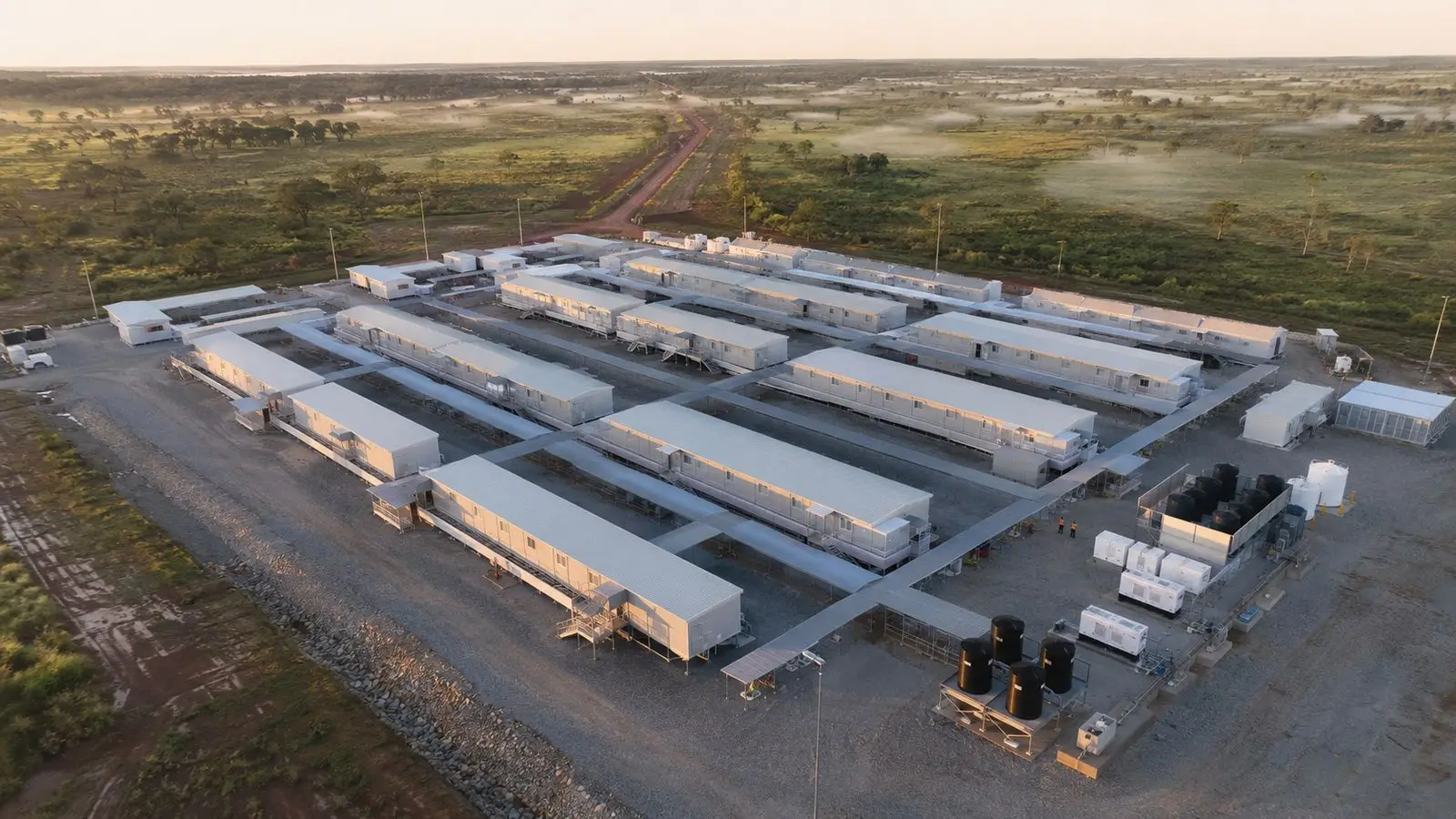
Offices and camps that arrive installed
Interconnectable modules to operate anywhere: oil, mining and military camps, site offices and mobile classrooms. Fabricated with pre-integrated MEP at the group plant, shipped flatpack and dry-assembled — deployment in weeks, not months.
- Deployment in weeks: modules arrive finished from the plant and on site they are only assembled and interconnected.
- Flatpack optimised for standard containers — direct export from Panama.
- Relocatable and reusable between projects: the camp is dismantled and moved to the next operation.
- Pre-integrated MEP: electrical and plumbing installations executed at the factory, not improvised on site.
Remote operations without improvisation.
Oil, mining, defence and construction companies set up operations where there is no infrastructure — and need it working from day one.
A camp is not a minor building: it is dormitories, dining halls, offices and laboratories that must operate fully from mobilisation. On an oil front, a mine or a military base, every day without facilities is paid in unhoused staff and idle equipment. And wet construction on a remote site — with material haulage, scarce local labour and adverse weather — multiplies timelines and risks that the operation's schedule does not tolerate.
SmartBrix solves that equation with interconnectable prefabricated modules: they are fabricated with panels, finishes, electrical and plumbing installations integrated at the group's CNC plant (NewCon Steel®, Las Mañanitas · EMMA regime), travel flatpack optimised for standard containers and are dry-assembled on foundation pads. The result: deployment in weeks and complete modular projects in 60–120 days — up to 90% faster than traditional construction. Oil, mining and military camps are part of the experience behind SmartBrix's modular construction system, alongside a portfolio of 350+ delivered projects over 15+ years.
The life cycle does not end with the campaign either: because assembly is dry, the camp is disconnected, dismantled and reused on the next project. The same asset serves several operations, reduces total cost compared with building anew on every site and generates up to 30% less construction waste. Logistics follow that mobility: from the group plant in Las Mañanitas, Panama City, modules are exported directly to Central America, the Caribbean and Latin America (Panamanian certificate of origin, HS 72.16, available; import treatment is decided by the destination customs), with design calculated to the code of each jurisdiction — NSR-10 in Colombia, REP-2021 in Panama and IBC where applicable.
Six advantages for temporary and remote operations.
What the modular format solves in camps and offices — from outbound logistics to the close of the operation.
-
01
Weeks to deploy
Modules arrive finished from the plant: on site, pads are poured, modules are set and interconnected. A complete modular project is delivered in 60–120 days.
-
02
Efficient flatpack transport
The flatpack format optimises every standard container: more modules per shipment and viable logistics to remote sites, with direct export from Panama.
-
03
100% relocatable
Dry assembly, no demolition: at the close of the operation the camp is dismantled and moved complete to the next front.
-
04
MEP ready from the plant
Electrical and plumbing installations executed at the factory as part of the production process — under RETIE in Colombia. On site, only the networks are connected.
-
05
Configuration by interconnectable modules
Dormitories, dining halls, offices, laboratories and health posts combine and expand module by module as the operation grows.
-
06
Lower total cost through reuse
The same asset is amortised over several campaigns and generates up to 30% less construction waste than traditional building.

Interconnectable modules · relocatable offices and camps
One format, four frequent uses.
Interconnectable modules are configured to the operation — these are the sector's most requested uses.


Format, timelines and logistics for the sector.
The data an operations manager needs to evaluate a modular camp.
- Format
- Interconnectable and flatpack modules — dormitories, dining halls, offices, laboratories and health posts
- Deployment
- Weeks · complete modular project in 60–120 days
- MEP
- Pre-integrated from the plant: factory-fitted electrical and plumbing installations (RETIE in Colombia)
- Transport
- Standard container — direct export from Panama
- Reuse
- Demountable and relocatable: the same camp serves several operations
Frequently asked questions about modular camps and offices.
How long does it take to install a modular camp?
Can the modules be moved to another operation?
Do the modules include electrical and plumbing installations?
Do you serve remote sites outside Colombia and Panama?
Your camp, operating in weeks.
Tell us the location, headcount and required uses — reply within 24 business hours and technical proposal in 48 h.